
featured stories
A closer look at projects where storytelling, design, multimedia, and strategy came together to create meaningful experiences.
FEATURED STORY
When Storytelling Preserves a Culture
The Inuit Cultural Online Resource (ICOR)
Some projects ask you to build a website.
Others ask you to solve a much bigger problem.
This was one of those projects.
The challenge wasn’t simply to organize information or create an attractive online experience. It was to help preserve and share Inuit culture, traditions, knowledge, and lived experiences in a way that felt authentic, respectful, and engaging for future generations.
Technology alone couldn’t accomplish that.
Storytelling could.
The Challenge
Imagine trying to teach someone about a culture they have never experienced.
You can present facts, dates, and definitions, but information alone rarely creates understanding. Understanding comes from people, places, voices, memories, and experiences.
The goal was to create a resource that would allow educators, students, and communities across Canada to connect with authentic Inuit stories and knowledge in a meaningful way.
That required more than good design.
It required listening.
My Role
This project became far more than a website.
From the original concept and proposal through funding, planning, content gathering, interviews, photography, video production, editing, information architecture, and final development, I was involved throughout the entire process.
Every decision served the same objective:
How can we help someone feel connected to a story they may never have the opportunity to experience firsthand?
The technology was simply the vehicle.
The people and their stories were the destination.
It required listening.
The Result
The finished resource became an educational and cultural platform used by teachers, students, government organizations, and communities to explore Inuit culture through authentic voices and experiences.
More importantly, it demonstrated something I have carried into every project since.
People connect with information when they first connect with humanity.
Facts are important.
Stories are memorable.
Experiences are transformative.
Why It Matters
Before working on this project, I believed storytelling was primarily a way to communicate information.
After working on it, I understood that storytelling is how we preserve identity, build understanding, and create lasting connections.
That lesson continues to influence every website I design, every video I produce, every photograph I capture, and every customer experience I help shape.
Because whether we’re preserving a culture or growing a business, the objective is remarkably similar:
To create something meaningful enough that people want to carry the story forward.

FEATURED STORY
Building Trust Through Community Communication
Wabano Centre for Aboriginal Health
Introduction
Some stories are told through words.
Others are told through experiences shared by an entire community.
This was one of those stories.
Working with the Wabano Centre for Aboriginal Health meant contributing to an organization whose mission extended far beyond promoting events or sharing information. Every communication represented an opportunity to strengthen relationships, celebrate culture, and encourage people to participate in something meaningful.
The objective was never simply to attract attention.
It was to create connection.
The Challenge
Healthcare communication carries a unique responsibility. Information must be clear, accessible, culturally appropriate, and engaging while serving people with diverse backgrounds and needs.
Every event, campaign, announcement, photograph, social media post, and webpage contributes to the public’s perception of the organization.
The challenge wasn’t creating individual pieces.
It was creating a consistent experience.
My Role
Working with the Wabano Centre for Aboriginal Health meant contributing to a communications team whose purpose extended well beyond promoting events or sharing information. Every project was an opportunity to strengthen relationships and help tell the story of an organization deeply connected to its community.
My work included website updates, social media content, email campaigns, event promotion, photography, print materials, digital signage, and visual storytelling across a wide variety of initiatives.
One particularly memorable example was the Wabano Igniting the Spirit Gala. Long before guests arrived, the experience had already begun through invitations, digital campaigns, and communications designed to build anticipation and encourage participation.
When the evening finally arrived, I documented the event through photography, capturing moments of celebration, culture, and community. Those images then continued telling the story long after the event had ended.
Every communication became another chapter in the same narrative.
The Result
Successful communication often feels effortless.
People know where to go.
They understand what is happening.
They feel welcomed.
They participate.
Behind that experience is careful planning, consistent messaging, thoughtful design, and storytelling that remains authentic across every touchpoint.
Looking back, I realized that the individual pieces were never the goal.
Together, they created trust.
Why It Matters
This experience reinforced a belief that continues to shape my work today.
Marketing may attract attention, but experiences create memories.
Those memories become stories that people willingly share with others.
Whether the goal is supporting a community, growing a business, or celebrating a culture, communication is not a collection of isolated posters, emails, photographs, or webpages.
It is one continuous story experienced across hundreds of interactions.
When those interactions are thoughtful and consistent, people don’t just understand the message.
They become part of it.

FEATURED STORY
When Great Storytelling Goes Unnoticed
Film & Television
Introduction
Some of the most important storytelling is never noticed by the audience.
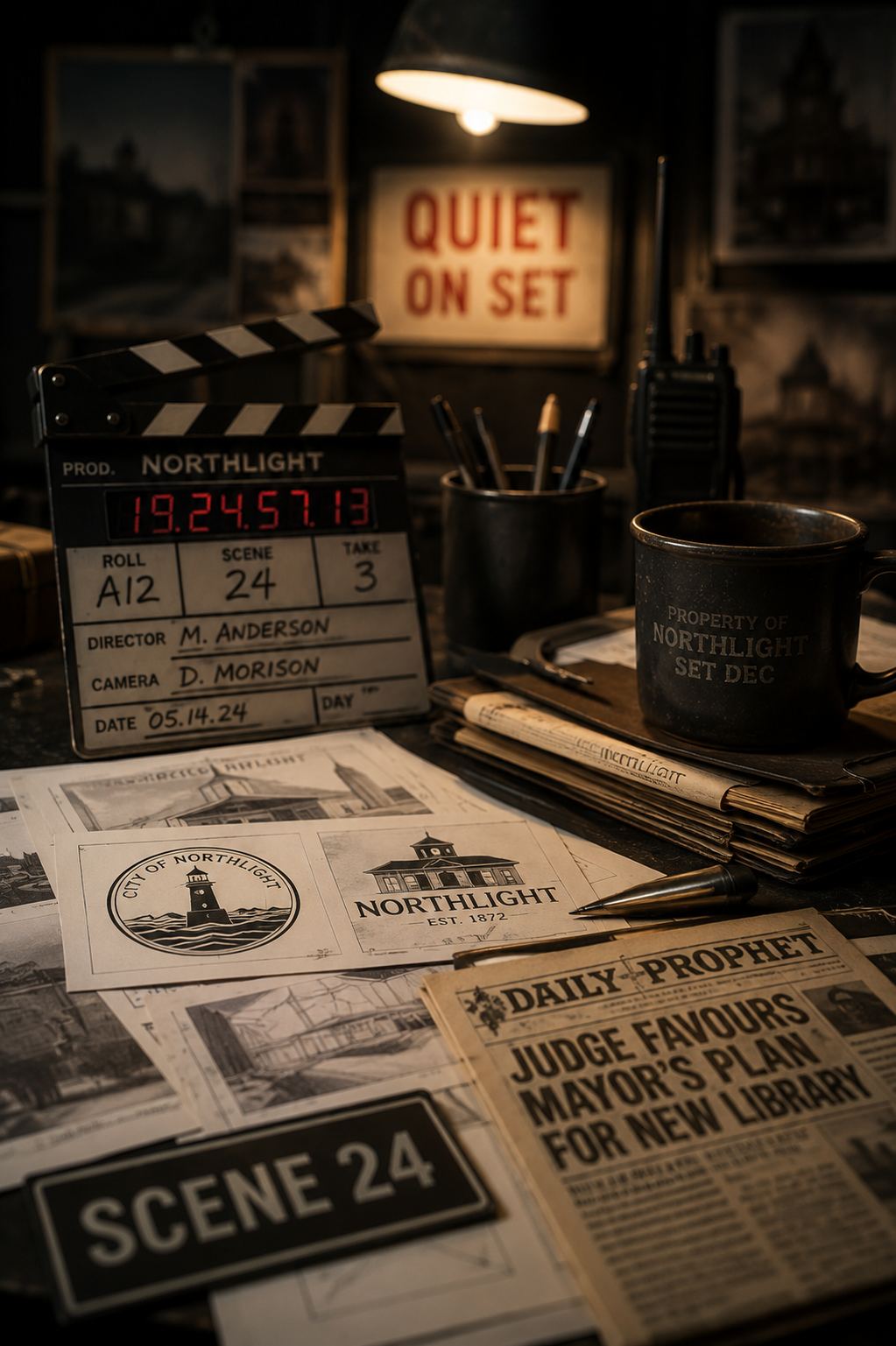
People remember the characters, the dialogue, and the emotion of a scene. They rarely think about the newspaper someone is reading, the graphics on a computer screen, the sign hanging in a shop window, or the countless visual details that quietly make a fictional world feel believable.
Yet those details matter. Something as simple as a character picking up a book of matches. The right graphic can tell the viewer something about the type of place it is, a motel, a bar, an upscale lounge, small details help tell the story without you giving it a second thought.
They help transform a set into a world and a script into an experience.
The Challenge
Film and television demand authenticity. Every visual element must support the story without distracting from it. If something looks wrong, the audience may not know exactly why, but the illusion is broken.
The challenge is to create supporting visuals that feel completely natural while serving the needs of the production.
Ironically, success often means your work goes unnoticed.
My Role
I worked on multiple film productions creating screen graphics, printed materials, props, and visual elements designed specifically for each story. Every piece had to match the narrative, the characters, the time period, and the creative vision of the production.
This required understanding not only design but storytelling itself.
Every decision had one objective:
Help the audience believe what they were seeing.
Film production leaves very little room for delay. Sets are booked, crews are scheduled, locations are rented, and actors may be available for only a limited time before moving on to the next production. The work often happens under immovable deadlines where a missed delivery can affect an entire day’s shooting. It reinforced the importance of preparation, adaptability, and producing creative solutions quickly without compromising quality.
The Result
When visual storytelling is successful, audiences stop noticing individual design elements and become immersed in the experience.
The graphics don’t compete with the story.
They support it.
They create consistency, authenticity, and credibility, allowing the narrative to unfold naturally.
The best compliment is often that nobody notices the work at all.
Why It Matters
Working in film and television reinforced a lesson that continues to shape every project I take on today.
Every detail tells a story.
A website.
A brand.
A brochure.
A photograph.
A sign.
A social media post.
Each one may seem small on its own, but together they create an experience that either strengthens or weakens the story.
People don’t always notice great storytelling.
But they almost always notice when it is missing.
FEATURED STORY
Seeing What Others Miss
Creative Strategy
Introduction
Some people see a logo.
Some people see a website.
Some people see a brochure or a social media post.
I see the story connecting them all.
Throughout my career, I’ve learned that businesses rarely struggle because they lack talent or quality products. More often, they struggle because their story is fragmented. Their website says one thing, their social media says another, their customer experience says something else, and their brand becomes inconsistent.
People don’t consciously analyze these details.
They simply leave with an impression.
The Challenge
Most organizations focus on individual pieces instead of the complete experience.
A great website cannot overcome poor communication.
An outstanding product cannot fully compensate for confusing messaging.
Beautiful design loses its impact if the customer experience doesn’t support the promise.
The challenge is to see the entire journey through the eyes of the customer and ensure every interaction tells the same story.
My Role
My role has never been limited to design.
I ask questions.
I look for inconsistencies.
I identify opportunities that others may overlook and connect photography, video, writing, motion graphics, branding, web design, and customer experience into one cohesive narrative.
Every project begins with the same objective:
What should people feel?
Once that answer is clear, the creative decisions become much easier.
The Result
When every touchpoint supports the same message, trust grows naturally.
Customers become more confident.
Employees become better ambassadors.
Brands become memorable because they deliver an experience that matches their promise.
The story no longer exists in one advertisement or one webpage.
It exists everywhere.
Why It Matters
Over the years, I’ve come to believe that storytelling is not something you add to a business.
It is the business.
Every email.
Every sign.
Every photograph.
Every conversation.
Every website.
Every interaction either strengthens or weakens the story people tell themselves about your organization.
My job is to help make sure they’re telling the story you intended.

LET’S CREATE SOMETHING
PEOPLE REMEMBER.
Whether you’re building a brand, launching a campaign, or telling a complex story, let’s create something people remember and worth sharing with others.